
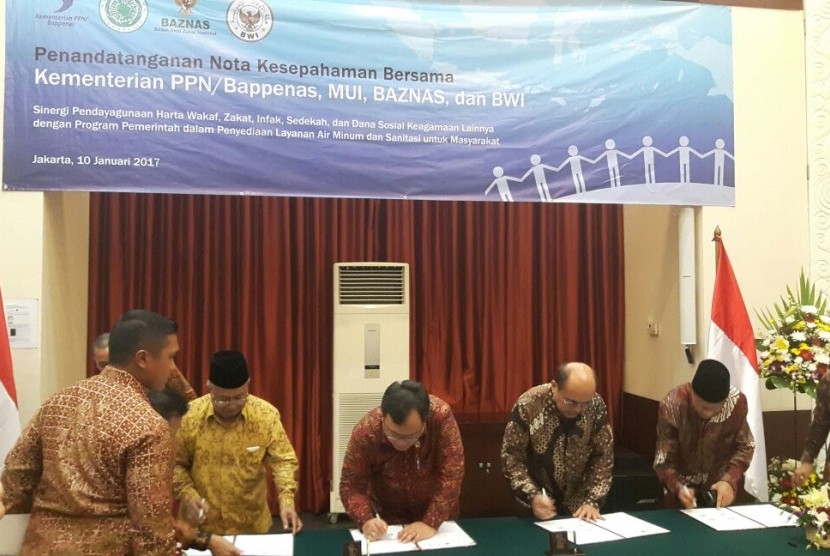
Badan Amil Zakat Nasional (Baznas) signed a memorandum of understanding (MoU) of cooperation in providing clean water and sanitation with the National Development Planning Agency (Bappenas), the Indonesian Ulema Council (MUI), and the Indonesian Waqf Board (BWI) at Bappenas Office, Tuesday (10/1).
The parties agreed to cooperate in the field of utilization of zakat, infaq, shadaqah and waqf (ZISWAF) as well as other religious social funds. These funds will be used for the construction of drinking water and sanitation for the society, adopting the approach of Community Based Total Sanitation (STBM).
Chairman of Baznas Bambang Sudibyo said that this cooperation is a momentum for Baznas to distribute zakat, infaq, shadaqah and other religious funds as well as possible.
"Baznas support the provision of sanitation and clean water, and we'll do the distribution in accordance with asnaf (groups entitled to receive zakat), not only in Central Baznas but we will also involve the entire Baznas Province and LAZ," he said.
Bambang said that this cooperation is a program that will easily attract muzaki to give zakat through official zakat institutions. According to him, one of the problems is that many muzaki who do not give the zakat through official zakat institutions in accordance with guidance of the Qur'an and the rules in the Act.
"To collect zakat as well as possible, it needs a credible, accountable and right on target distribution to liberate the poor from various problems, one of which is the problem of clean water and sanitation," he said.
He said, Baznas will fully support this program because according to what has been declared by Bappenas, that zakat, infaq, and shadaqah are parts of a program to achieve Sustainable Development Goals (SDGs). Zakat is also included in the Islamic financial architecture masterplan designed by Bappenas.
Meanwhile, the Minister of National Development Planning (PPN) / Head of Bappenas, Bambang Brojonegoro said that this cooperation is initiated by Bappenas as the coordinator of SDGs and the MUI which has authority to issue a Fatwa ZISWAF for the purposes of clean water and sanitation.
One ambitious goal of this program is no poverty, which focuses on poverty alleviation in Indonesia, one of which is limited access to basic services.
"In the provision of basic access, sometimes we forget the clean water and sanitation. Without them, we could not create a healthy family, even a third of children under five in Indonesia suffered stunting (malnutrition), "said Bambang.
He said that a way to prevent it is to provide adequate access to clean water and sanitation. The government provides funding through the APBN and APBD, but the amount is limited, so that it needs to be assisted by other budget that is zakat and waqf.
(Source: republika.co.id/amelya/puskasbaznas.com)